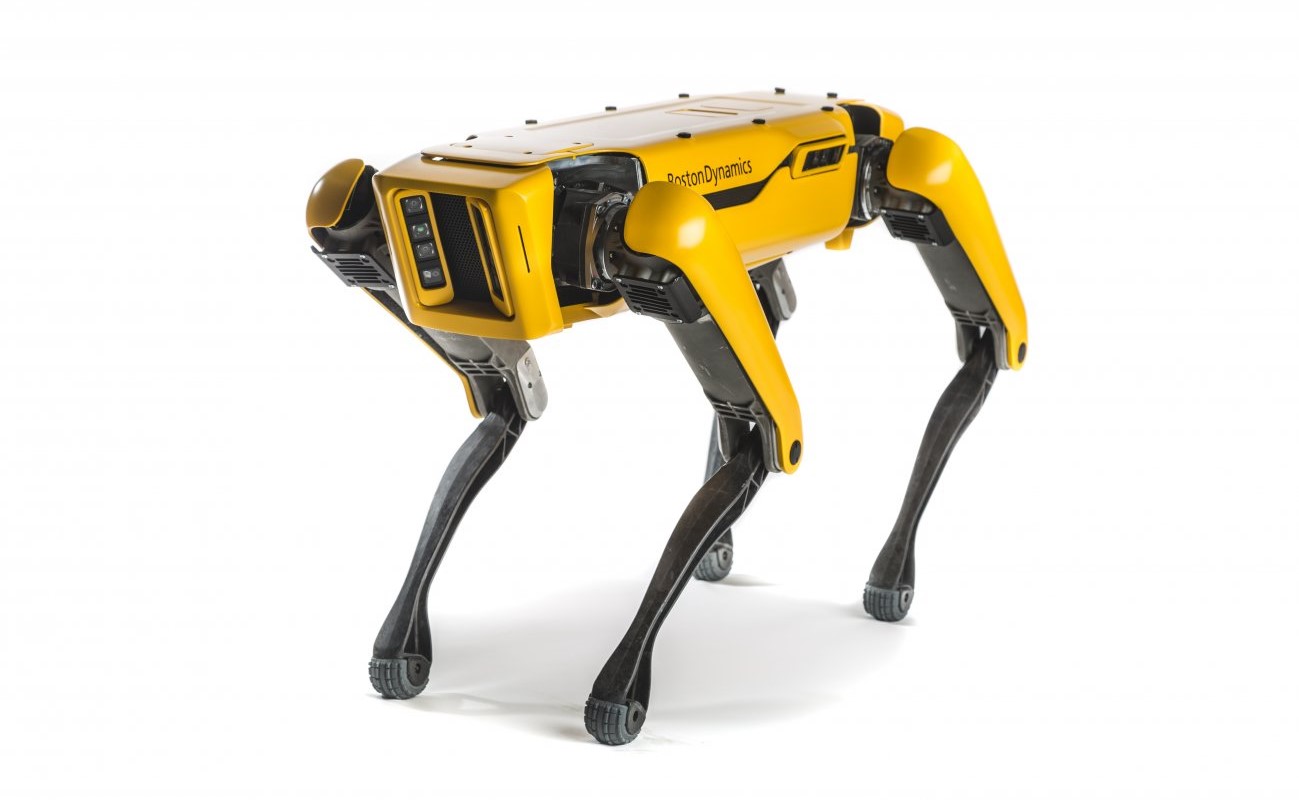
How Spot the Robot Dog Mapped Radiation at Chornobyl
October 27, 2020In October 2020, the State Agency of Ukraine on Exclusion Zone Management reported that Boston Dynamics' four-legged robot Spot had been tested for the first time in the Chornobyl Exclusion Zone in northern Ukraine, the area around the nuclear power plant that many English-language sources still spell Chernobyl.
What the 2020 mission surveyed
Specialists from the State Specialized Enterprise "Central Enterprise for Radioactive Waste Management" (CERWM) and researchers from the University of Bristol assessed radioactive contamination. They carried out radiometric and geophysical work on two sectors of the Red Forest temporary radioactive waste storage site and at the Pidlisnyi and Buriakivka radioactive waste disposal sites.
Spot was one tool among several. The teams also used drones and ground-based robotic systems with a gamma spectrometer, lidar, photogrammetry, hyperspectral and neutron sensors. The 3D images and data they collected were intended for updated maps of radiation levels in these areas.
The Bristol team also walked Spot inside the New Safe Confinement, the steel arch over the remains of Reactor 4. According to IEEE Spectrum, the robot carried a collimated radiation sensor and produced a map of radiation coming from the front wall of the reactor building. The researchers pointed to a less obvious advantage of legs: radioactive dust is a major concern inside the confinement, and a legged robot touches the floor at far fewer points than a wheeled or tracked one, so it disturbs less material.
Why Spot suits inspection work
Boston Dynamics began selling Spot to US businesses in June 2020 for $74,500. For inspection teams, three features matter most. A standard payload interface lets operators mount extra sensors such as cameras, lidar or radiation detectors. Autowalk lets an operator record a route once and have the robot repeat it autonomously, so readings are taken at the same points on every run. And the Spot SDK, published on GitHub with a Python client library, lets developers integrate custom sensors and send the data to their own systems.
That repeatability is the main gain over manual surveys. In 2020, routine weekly measurements in contaminated spaces at Chornobyl were still taken by people, which put them at risk. A robot on a scheduled route keeps staff outside and produces data sets that can be compared over time.
From trials to routine use
In 2021 Sellafield Ltd in the UK ran a three-day trial of Spot at the Calder Hall power station, which is being decommissioned. According to a UK government case study, Sellafield went on to use robot dogs for routine inspections in a highly radioactive area in 2023/24, and in 2025 operated one remotely from outside the nuclear-licensed site boundary.
At Chornobyl, remote monitoring has become even more important. Russian forces occupied the site from February 24 to March 31, 2022; the zone's automated radiation monitoring system had to be re-established afterwards, and staff reported that laboratories there had been looted. On February 14, 2025, a drone pierced the roof of the New Safe Confinement. Radiation levels did not rise, but in December 2025 an IAEA mission concluded that the structure had lost its primary safety functions, including confinement.
Inspection robots and their software in 2026
Boston Dynamics has been controlled by Hyundai Motor Group since June 2021, and in July 2026 the group said it was pursuing the purchase of SoftBank's remaining stake. Spot now competes with other legged inspection robots, such as ANYmal from Zurich-based ANYbotics, which also offers ANYmal X for potentially explosive areas in oil, gas and chemical plants.
For businesses, the robot is only half of the system. Much of the value is in the software: pipelines that collect readings from every mission, tag them with time and location, compare them with earlier runs and raise alerts; digital twins that place those readings on a 3D model of a facility; and natural-language interfaces. One engineer has already connected Spot to ChatGPT so that it can answer spoken questions about its missions. Integrations like these depend on the robot's API, which is why inspection robotics is as much a software project as a hardware purchase.