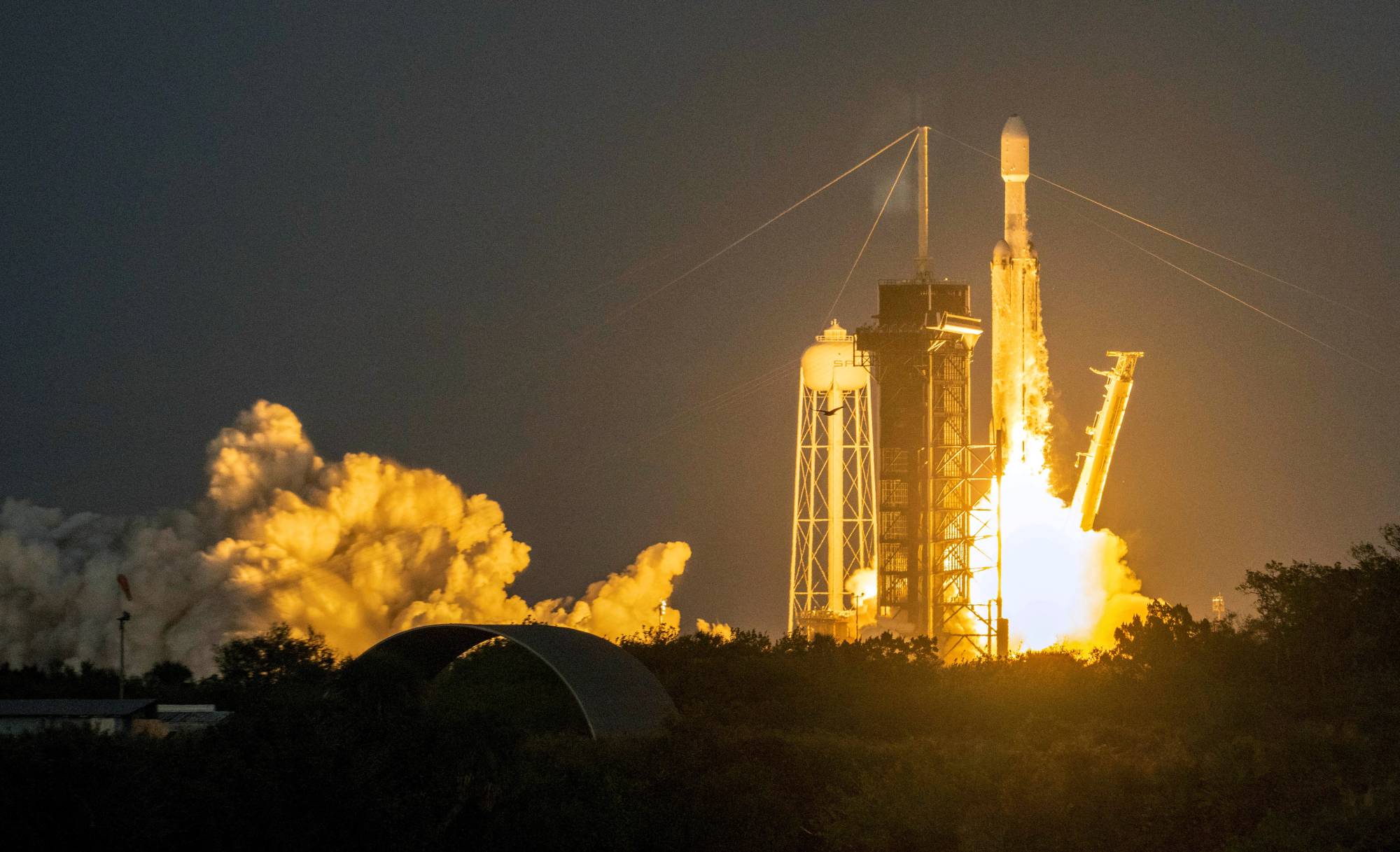
Elon Musk’s SpaceX firm set to fly giant Starship rocket system
May 01, 2023Update (October 2026): The Monday attempt on 17 April 2023 was called off because of a frozen pressurisation valve on the booster. Starship lifted off on 20 April 2023 and damaged its launch pad, but several engines failed, the two stages never separated and the flight termination system destroyed the vehicle nearly four minutes into the flight (see Musk’s reaction after the launch). Later test flights went much further: on Flight 5 in October 2024, the launch tower caught the returning Super Heavy booster for the first time.
SpaceX announced that the most powerful rocket ever developed would attempt a maiden launch on Monday. The rocket named Starship stands almost 400 feet high and is designed to have almost double the thrust of any rocket in history. Happening at their SpaceX plant in Boca Chica, Texas, Starship is programmed to perform an uncrewed demonstration if it launches successfully.
Mr Musk appealed to the public, saying: “It’s the first launch of a very complicated, gigantic rocket, so it might not launch. We’re going to be very careful, and if we see anything that gives us concern, we will postpone the launch”. SpaceX aims to send the upper stage of the vehicle eastward to complete almost one circuit of the globe, and the unique feature of the giant Starship is that it is designed to be fully and rapidly reusable.
Starship has been undergoing tests since February. The top segment has been tested on short hops, and the mammoth booster, also known as Super Heavy, was fired while clamped to its launch mount, though the engines on that occasion were throttled back to half their capability.
If the Starship is successfully launched, SpaceX programmed it to deliver something close to 70 meganewtons at takeoff, and at a point, the two halves of the rocket will separate with the top section pushing on with its engines for six minutes and 23 seconds. The speed rate by now must have propelled it over the Caribbean through space more than 100km above the planet's surface.
Further programming by SpaceX is for the Super Heavy booster to fly back near the Texan coast and come down vertically to hover above the Gulf’s water, topple over and sink. The ship itself will re-enter the Earth’s atmosphere after almost a full revolution of the Earth, coming down in the Pacific just north of the Hawaiian islands. It’s been given protective tiling to cope with the immense heating it will experience while descending. The belly flop into the ocean is timed to occur 90 minutes after lift-off.
Mr Musk’s dream to make humans an interplanetary species could come true with the progress he has made in rocket production so far. A notable guest among other spectators to grace the launch will be the US space agency, Nasa. Mr Musk concludes by saying: “If we do launch, I would consider anything that does not result in the destruction of the launch pad itself to be a win”.